Best Java Algorithm Books in October 2026
Data Structures and Algorithms in Java


Data Structures and Algorithms in Java
Essential Data Structures and Algorithms in Java: Apply proven problem-solving patterns to write faster and cleaner AI-native code
Data Structures and Algorithm Analysis in Java
- AFFORDABLE PRICES ON QUALITY USED BOOKS FOR BUDGET-SAVVY READERS.
- DETAILED CONDITION DESCRIPTIONS ENSURE CUSTOMER SATISFACTION.
- ECO-FRIENDLY CHOICE: PROMOTE RECYCLING THROUGH SECONDHAND BOOKS!
Data Structures and Algorithms Using Java
Data Structures and Algorithms in Java: A Project-Based Approach
Data Structures and Algorithms Made Easy in Java: Data Structure and Algorithmic Puzzles
- MASTER DATA STRUCTURES AND ALGORITHMS FOR LONG-TERM SUCCESS!
- SOLVE PRACTICAL PUZZLES TO ENHANCE YOUR CODING SKILLS EFFECTIVELY!
- ENJOY LASTING BENEFITS FOR YOUR PROGRAMMING CAREER WITH OUR GUIDE!
Elements of Programming Interviews in Java: The Insiders' Guide
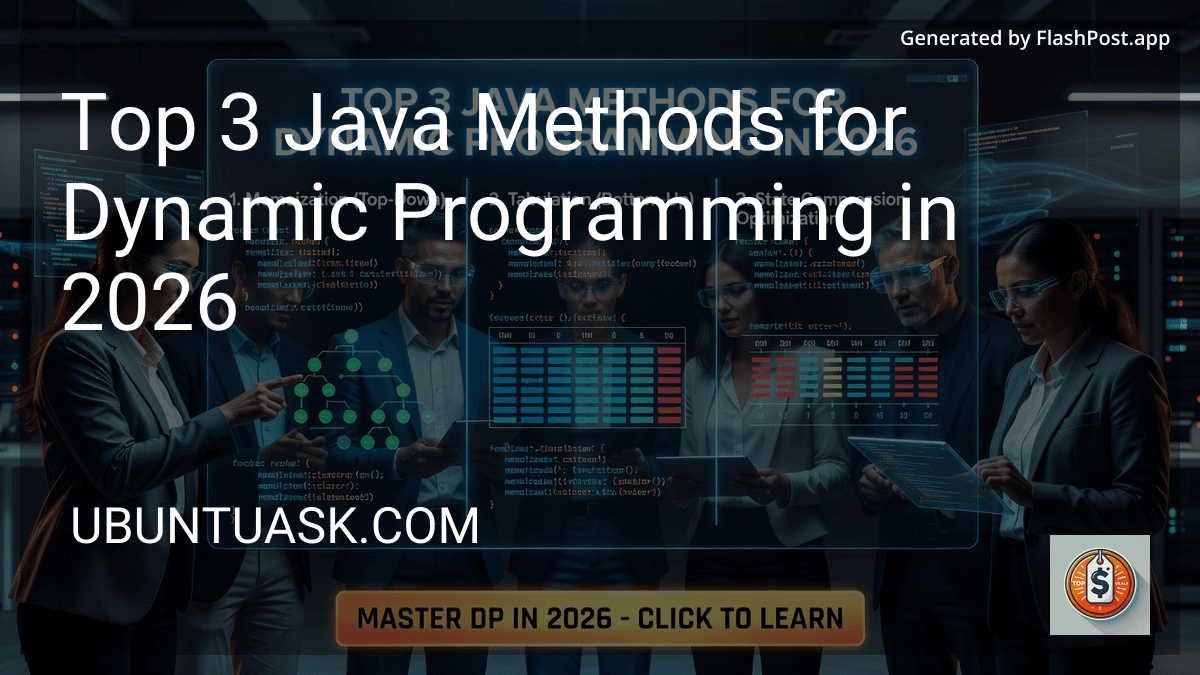
The Future of Java: Top 3 Java Methods for Dynamic Programming in 2026
Java continues to evolve at a rapid pace, and as we look towards 2026, the need for dynamic programming approaches in Java becomes increasingly critical. As technology advances, developers face complex problems that require more sophisticated solutions. Did you know that many experts predict a 20% increase in demand for Java-based dynamic programming skills? This is why understanding the top Java methods to tackle these challenges is crucial.
This guide will dive into the top three Java methods for dynamic programming you'll need to master in 2026. You'll discover how these methods can simplify your coding process and make your applications more efficient. By the end, you'll be better equipped to choose the right method for your project.
Understanding Dynamic Programming in Java
Dynamic programming is a powerful technique used to solve complex problems by breaking them down into simpler subproblems. Java's capabilities make it an ideal language for implementing dynamic programming algorithms. But what exactly should you be on the lookout for?
Key Methods for Successful Dynamic Programming
-
Memoization Technique
- Efficiency: Memoization stores the results of expensive function calls and reuses them when the same inputs occur again, significantly reducing computation time.
- Ease of Implementation: Offers a straightforward approach, suitable for problems like Fibonacci numbers or handling dates and times in Java.
-
Bottom-Up Approach
- Iterative Precision: Builds from base cases and works upwards, making it easier to manage and reducing stack overflow errors common with recursion.
- Optimal Path Recovery: Useful in applications like dynamic pathfinding where understanding the optimal path is crucial.
-
Tabulation Method
- Non-recursive Solution: Generates tables to store subproblem solutions, which is memory-efficient and great for problems with overlapping subproblems.
- Suited for Larger Problems: Ideal when you're dealing with massive datasets or complex algorithms like 2025 Java cybersecurity trends.
Benefits of Mastering These Java Methods
Understanding and applying these Java methods can transform not only how you code but also the efficiency and scalability of your projects. Here's why this matters to you:
- Enhanced Performance: Your programs will run faster, thanks to reduced computational overhead.
- Scalability: Whether dealing with small apps or large enterprise systems, these methods ensure your code can grow without a hitch.
- Increased Problem-Solving Abilities: Dynamic programming allows you to tackle complex problems efficiently, giving you a competitive edge in software development.
Expert Recommendations for Dynamic Programming
Pro Tip: Always start with the simplest method; often, memoization will suffice. For larger problems, consider tabulation or the bottom-up approach.
- Avoid Overhead: Be mindful of memory usage, especially when choosing between recursive and iterative methods.
- Start Small: Test your algorithms on small datasets to identify bugs before scaling up.
- Iterative Over Recursive: Whenever possible, choose iterative methods to prevent stack overflow and enhance understanding.
Getting Started: Choosing the Right Method for Your Project
To implement dynamic programming efficiently, begin by understanding the problem at hand. Ask yourself:
- Is there an obvious base case or simpler subproblem?
- How can you break the problem down? Is memoization enough, or do you need tabulation?
Next Steps:
- Analyze the Problem: Determine if the problem has overlapping subproblems or optimal substructure, which is ideal for dynamic programming.
- Choose Your Method: Begin with memoization for smaller problems, and consider tabulation for larger, complex cases.
- Implement and Test: Build small, scalable tests before moving to full-scale implementation. Explore resources like the Java Swing JPanel JFrame tutorial for UI elements as needed.
Feeling inspired? Now's the time to put these skills to work and start crafting more efficient, powerful Java applications. By honing these dynamic programming techniques, you'll blaze a trail in the ever-evolving tech landscape.
Frequently Asked Questions
How is dynamic programming different from recursion in Java?
Dynamic programming optimizes recursion by storing results of subproblems to avoid redundant work, while recursion may repeatedly solve the same subproblem, leading to inefficiency.
Why is memoization popular for dynamic programming in Java?
Memoization is favored for its simplicity and effectiveness in reducing time complexity, making it ideal for problems with overlapping subproblems like Fibonacci sequences.
What are common use cases for dynamic programming in Java?
Dynamic programming in Java is commonly used in optimization problems, where you need to find the best solution among many, such as shortest path, knapsack problem, and passing list in Java.
Can dynamic programming improve Java applications' performance?
Absolutely. By reducing redundant calculations and efficiently solving complex problems, dynamic programming significantly boosts the performance and scalability of Java applications.
When should I choose tabulation over memoization in dynamic programming?
Choose tabulation when dealing with larger datasets and when you want to avoid the overhead of recursive stack space, especially in problems with a small set of distinct subproblems.